
What 'End-to-End Customer Experience' Really Means
The customer experience is shaped long before a customer interacts with your brand. It emerges from where you operate, how your network is designed, how customers access you, and how decisions propagate across your organization.
Most organizations define the ‘end-to-end customer experience’ as the sum of every interaction a customer has across their journey. While true, this definition glosses over a critical point.
In practice, structural decisions determine the ceiling for the customer experience long before any interaction occurs. Your early decisions set the ceiling for customer experience. Leaders choose where to invest, how to design the network, and how to respond to market change. Those choices shape the assets and constraints that customers feel every day.
Because of this, customer experience reflects how well an organization aligns strategy, operations, and market realities over time.
Customer Experience Is an Outcome, Not a Department
Many companies try to improve customer experience by optimizing individual touchpoints. For example, they redesign customer journeys, retrain frontline teams, or improve messaging.
While these efforts help, they often address symptoms rather than root causes. Customers rarely leave because of one poor interaction. Instead, they leave when friction builds repeatedly. Long wait times, inconsistent availability, and/or better nearby alternatives gradually erode loyalty.
Therefore, improving the customer experience requires an system wide approach. Teams need to improve operations and make the right long-term investments that remove friction.

The Structural Drivers of End-to-End Customer Experience
Geography and Access
Your location/site investments do not reach every customer equally. Store locations relative to customers and competitors shape convenience. As neighborhoods grow, competitors enter, and locations close, the experience in a market can change—even if your store network stays the same.
Network Density and Coverage
Customers value choice and convenience, but density has tradeoffs. Too many stores can reduce profitability through cannibalization. Too few stores reduce convenience and create openings competitors can exploit. Getting market coverage right is critical for retention.
Assortment, Availability, and Flow
Operational issues such as stockouts or long wait times/shipping delays introduce friction. Customers experience these failures at the point of contact with your store, even though the root cause may lie much deeper in the system.
Competitive Proximity
Customers judge experience relative to nearby alternatives. Competitors shape expectations for price, convenience, and service quality. Two customers can report the same “great experience,” yet behave differently if one has stronger alternatives nearby. That’s why investments should reflect competitive pressure market by market.
Measuring the Economic Impact of Customer Experience
Improving customer experience only matters if it changes economic outcomes. Organizations need to connect experience drivers to retention, basket size, and ultimately customer lifetime value. When leaders do this, they can quantify which issues truly drive attrition and which improvements deliver real economic return.
Introducing Two Platforms: Location Intelligence and Retail Intelligence
Organizations cannot improve customer experience by looking at individual touchpoints in isolation.
The factors that shape customer experience span geography, competition, network design, inventory, labor, operations, and fulfillment. Decisions made in one area often create consequences somewhere else in the system.
To address this challenge, T²-Labs developed two complementary intelligence platforms:
The Location Intelligence Platform helps organizations understand how customers, competitors, and locations interact across a market. The Retail Intelligence Platform helps organizations understand how customers, inventory, labor, operations, and fulfillment interact inside the store environment.
Together, these platforms provide a connected view of the customer experience—from customer access and market convenience to operational execution and service delivery.
By combining digital twins, simulation, analytics, and scenario planning, organizations can evaluate decisions before implementation, identify the root causes of customer friction, and prioritize investments based on expected customer and financial outcomes.
Location Intelligence Platform
Capabilities include:
- Site Selection
- Network Optimization
- Trade Area Analysis
- Competitive Risk Assessment
- White Space Identification
- Market Opportunity Assessment
- Cannibalization Analysis
- Store Expansion Planning
Retail Intelligence Platform
Capabilities include:
-
- Store Digital Twins
- Cross-Functional Planning
- Operations Simulation
- Labor Workflow Design
- Checkout and Queue Analysis
- E-Commerce Fulfillment Simulation
- Scenario Optimization
Visualizing End-to-End Customer Experience Across an Organization
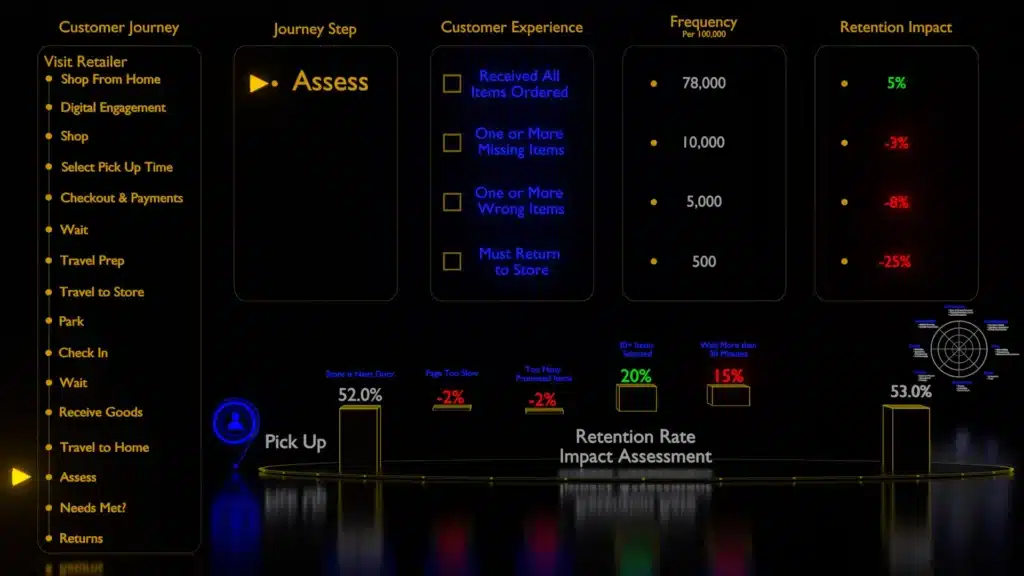
The visualization below shows how customer experience propagates across an organization. We start with the customer and focus on their inherent needs, grouping them into segments who value market offerings differently.
Decisions made in real estate, marketing, operations, and supply chain interact over time. When leaders see these relationships clearly, they can identify root causes instead of reacting to symptoms.
This view makes it possible to see how decisions in one area ripple across the system and ultimately shape customer outcomes.
From Insight to Action
Understanding experience is only the first step.
At T2-Labs, we help organizations identify which experience drivers matter most, measure their economic impact, and test alternative decisions before execution.
This approach connects strategy, analytics, and execution—so teams can act with confidence instead of intuition.
Apply This Approach
Learn how this approach translates into real decisions: